 Rakshit Narula
Beyond Social Media: Why Your Brand Needs an Integrated Digital Marketing Strategy
Customers don't live on one platform, and your brand shouldn't either. How to connect channels around one goal.
On this page
Many brands think digital marketing means posting on Instagram and boosting a few posts. Then sales stall, costs rise and nobody knows why. Today's customers search, scroll, compare, ask friends and read reviews before they buy. If your brand shows up in only one of those places, you lose them in the others. Here's why an integrated strategy works better, and how to build one.
Key points
- Customers move between many channels before buying, not in a straight line.
- Social media is powerful, but on its own it misses people who search, compare and come back later.
- An integrated strategy connects channels with one message and shared measurement.
- Start small: a few channels that work together beat many that work alone.
Why social media alone isn't enough
Social platforms are great at creating interest. But most people don't buy the first time they see a product. Google's research calls the space between first interest and purchase the "messy middle": people loop between exploring options and evaluating them, across search, reviews, videos and websites, until they decide.
If your brand only appears on Instagram, you're missing from most of that loop. Someone who liked your reel may later search on Google, find a competitor's ad first and buy there.
There's also a business risk. If one platform changes its algorithm, raises prices or suspends your account, your entire pipeline stops overnight.
What is an integrated digital marketing strategy?
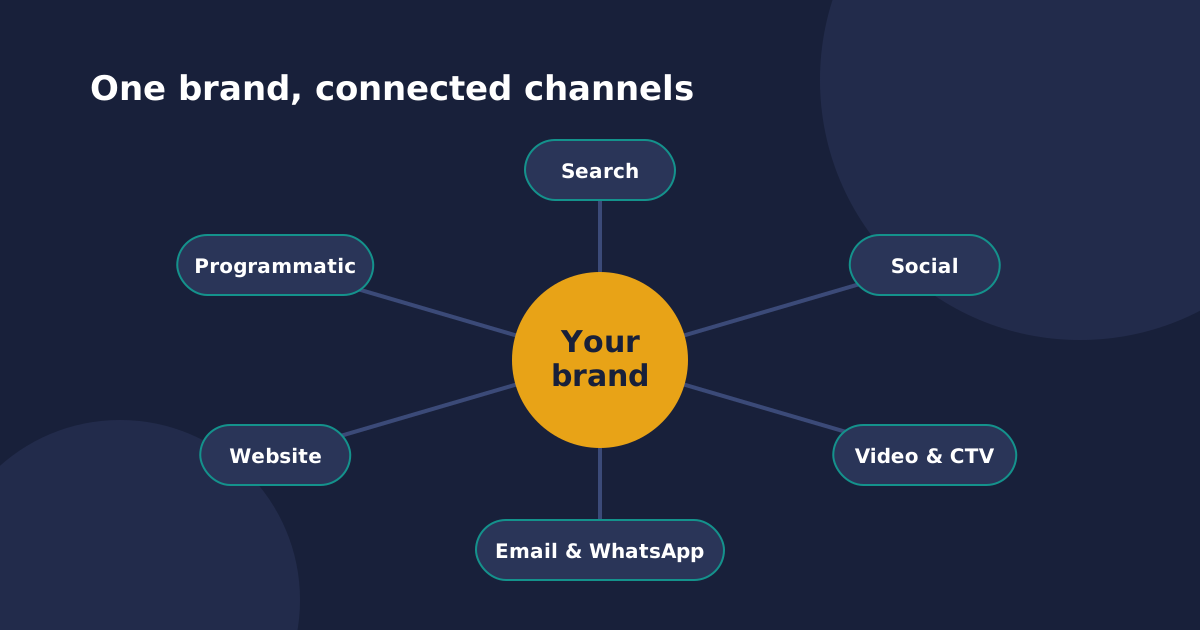
It means using several channels together, each with a clear job, sharing the same message, audience insights and goals. Instead of separate teams chasing separate numbers, everything works towards the same business result.
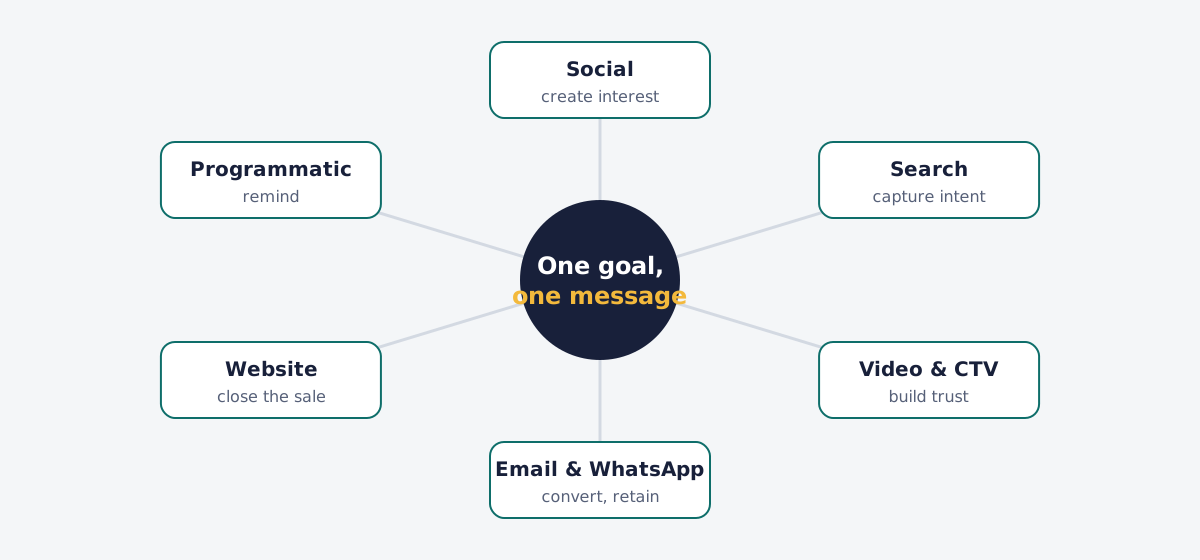
Give each channel a clear job
| Channel | Main job | Example |
|---|---|---|
| Social ads and content | Create interest and show your brand | Reels, creator videos, carousel ads |
| Search ads and SEO | Capture people actively looking | "best running shoes under 3000" |
| Video and CTV | Build trust and reach at scale | YouTube and streaming TV ads |
| Programmatic display | Stay visible and remind | Banners on news and lifestyle sites |
| Email and WhatsApp | Convert and bring customers back | Abandoned cart reminders, new launch alerts |
| Website and content | Answer questions and close the sale | Product pages, guides, reviews |
Example: a D2C footwear brand
Here's an example. A D2C footwear brand in Bengaluru spends all its budget on Instagram ads. Results are fine at first, but costs keep rising.
They rebuild their plan around one customer journey:
- Discover: Instagram reels and YouTube Shorts show the shoes in real use.
- Search: Google Search ads and SEO capture people searching their brand name and "comfortable office shoes".
- Remind: retargeting ads on social and programmatic display reach people who visited but didn't buy.
- Convert: a WhatsApp message offers size help, and an email reminds people about their cart.
- Return: customers get early access to new launches on email and WhatsApp.
Over the next quarter, total sales grow and the overall cost per customer comes down, even though Instagram alone now looks a little less impressive. The channels are helping each other. This is an illustration, but it reflects a common pattern.
Measure the whole journey, not one channel
Integrated marketing needs integrated measurement. If you judge each channel only by the last click before a sale, search and retargeting will look like heroes and social and video will look useless.
- Use data-driven attribution. Google Analytics 4 and Google Ads offer data-driven attribution, which uses your own data to share credit across the touchpoints that led to a conversion.
- Track blended results. Look at total revenue ÷ total marketing spend across all channels, not just each platform's own report.
- Watch brand search. If more people search your brand name after a social or video campaign, that campaign is working, even without direct clicks.
- Test with holdouts. Pause a channel in one city or region and compare results to see its real impact.
How to get started
- Map your customer journey. Where do people first hear about you, research you and buy from you?
- Pick three or four channels that cover discovery, consideration and conversion.
- Keep one core message across all of them, adapted to each format.
- Connect your data. Set up proper tracking and use consistent campaign tags (UTMs) everywhere.
- Review monthly on overall business results, then shift budget towards what grows the whole.
Final thoughts
Social media is a great starting point, but customers don't live on one platform, and neither should your brand. When channels share a message and a goal, each rupee works harder, and your business is no longer at the mercy of one algorithm.
Want help mapping your channel mix?
Send me a message with your current channels and goals, and I'll share where the gaps might be. Or subscribe for the next guide.
Sources
Liked this guide?
Subscribe and get an email whenever a new article is published. No spam, just practical marketing knowledge.